
Wealth Inequality- Getting Even Worse
Most people are familiar with the adage, “the rich get richer and the poor get poorer.” In the United States, that pattern holds true—and the gap has continued to widen over time.
In the decades following World War II, unions were strong and tax rates were higher, yet there was a broad sense of shared prosperity. This era is often regarded as one of the more economically equitable periods in modern U.S. history.
Since then, inequality has grown significantly, driven by the sharp decline in union jobs, soaring CEO compensation, a shift toward prioritizing shareholder returns over employee wages, and the offshoring of jobs amid globalization.
The Federal Reserve has closely monitored wealth inequality since 1989, but this focus overlooks earlier decades when key economic shifts were already underway. The 1970s saw the decline of unions, and the 1980s ushered in the rise of trickle-down economics. During that time, significant tax cuts reduced the top marginal tax rate from 70% to 28%, with the stated aim of stimulating economic growth. While these policies helped bring an end to stagflation, they also contributed to a dramatic increase in the national debt and shifted a greater share of the tax burden onto lower- and middle-income Americans.
The shift in the tax burden made it easier for the wealthy to accumulate more wealth, while making it increasingly difficult for others to get ahead. As a result, the rich have continued to grow richer, while the poor have fallen further behind. The graph below illustrates the distribution of wealth in the United States as of Q4 2025.
The data is provided by the Federal Bank website-
https://www.federalreserve.gov/releases/z1/dataviz/dfa/distribute/table/
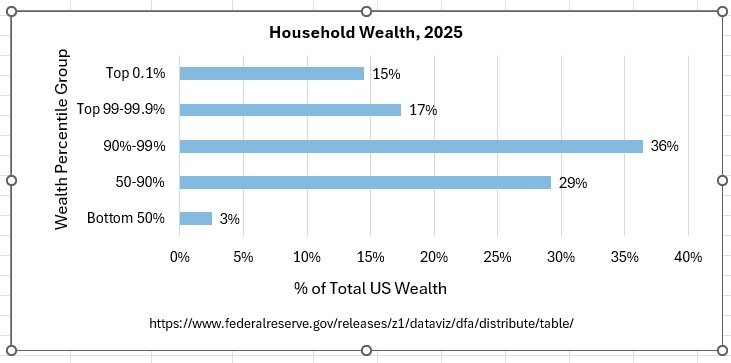
What the data show is that the bottom 50% of American households hold just 3% of the nation’s wealth, while the top half controls the remaining 97%. For those who feel they’re struggling, this helps put the imbalance into stark perspective.
The top 1% alone holds as much wealth as the bottom 90%. It’s a staggering disparity—one that not only defies intuition but also places increasing financial strain on those at the lower end of the spectrum.
It may be overly simplistic to claim that the wealthy support tax cuts solely to increase their own fortunes, but it is not an unreasonable conclusion given the influence of political action committees and campaign finance laws on elections and policymaking. Tax cuts, in particular, have often had the effect of preserving wealth at the top while shifting a greater share of the burden onto the bottom half of the population.
NOVA Idaho strongly supports tax reform that allows fair, progressive structure that asks more from the wealthy to alleviate the tax burden placed on the least wealthy. We also support a strong social safety net that includes a strong healthcare system and public education programs accessible to all.
If you would like to learn more about wealth and income inequality, please check out the sites below: